Card balance
How Moonfall Balances Its Cards
In Moonfall, a card that wins too often costs one more mana, and a card that loses too often costs one less. Here is how it works.
In Moonfall, a card's mana cost is not set in stone. Every public card's cost follows how it does in Multiplayer matches. If decks that carry a card win clearly more often than they should, the card costs one mana more. If they lose clearly more often, it costs one mana less. The game does the arithmetic on real match results, one mana at a time, so the card pool keeps finding its balance as players bring in new cards and build new decks.
Why Moonfall needs it
Most card games are balanced by a design team that tests a fixed set before release and patches it later. Moonfall's card pool does not stay fixed. Players keep adding to it in the Moon Foundry: fuse a pair of cards no one has fused before, and the game designs a brand-new card, with a mana cost its AI card designer picks to fit the idea. That first cost is an educated guess, and no team could playtest every card players discover. So the matches do it.
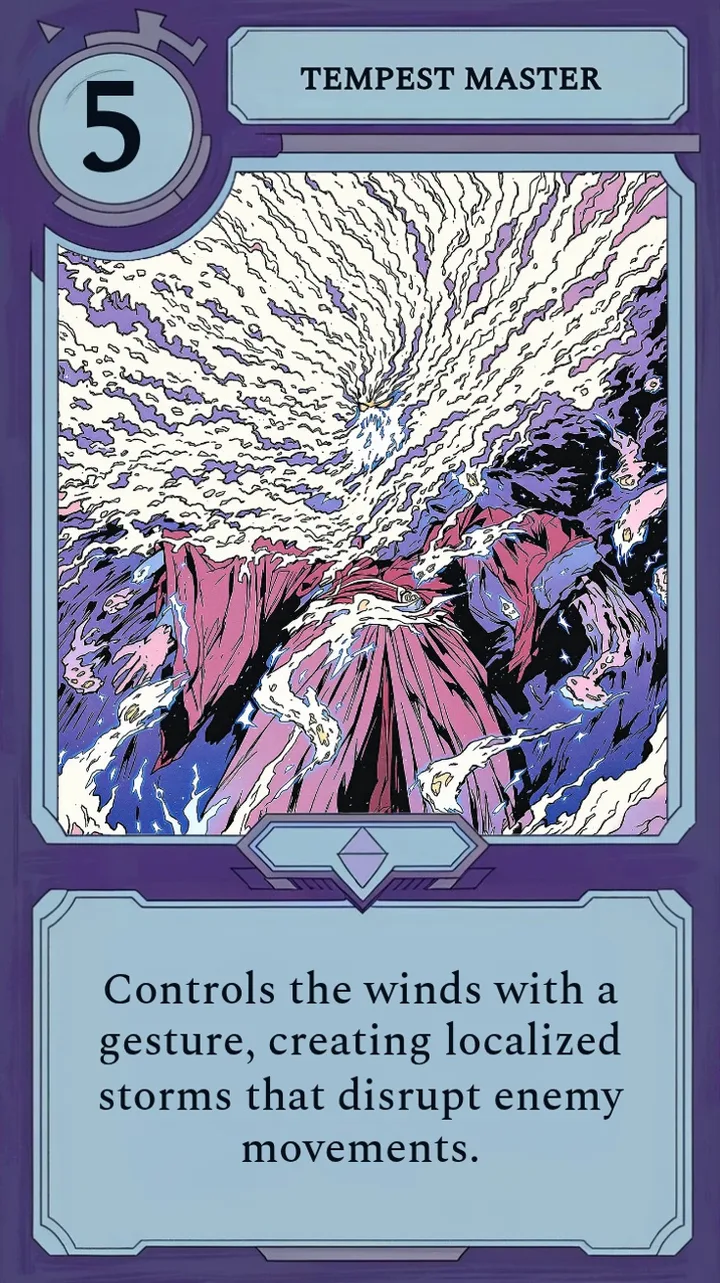
A Moonfall card has a name, a mana cost and a line of text, and no attack or health numbers. The AI Game Master decides what a card does in the moment; the cost decides how much of your turn it takes. That number is the one balancing moves.
Which matches count
Only matches that say something about the cards count:
- Multiplayer matches between two players. Games against the AI in Solo Adventure are kept separately and never change a cost. Tutorials do not count at all.
- Matches decided on the board. A match counts when one side's health reaches zero or a deck runs out, and both players have taken at least three turns. A forfeit, a disconnect, a turn timer running out or an abandoned match names a winner without a game being played, so none of those count.
- Both sides. The losing deck counts as much as the winning one.
Every public card is measured this way: the game's own cards and the public cards discovered in the Moon Foundry, Characters and Spells alike. A Stellar copy counts as the card it copies. What you create in Moon Dream goes to your own Collection rather than the shared card pool, so it is not balanced this way. The counts record cards and results, not who played them.
What the game measures
For each card, the game counts the Multiplayer matches in which it started in a deck, and how many of those its deck won. Every deck holds 15 different cards and both sides are counted, so across all cards the average comes out at exactly 50%. A card well above that is pulling its decks up; a card well below is holding them back.
It counts decks rather than the games in which a card was played, because a card you play when you are already ahead would look stronger than it is. How often a card is picked or played never changes its cost. A popular card just gets measured sooner.
When a cost moves
The bar is deliberately high, so a lucky streak cannot move a cost:
- A card needs at least 100 Multiplayer matches at its current cost before anything happens.
- The game works out the range its true win rate almost certainly lies in, at 99% confidence. The cost moves only if that whole range sits above 55% (too strong) or below 45% (too weak). Anything in between counts as balanced.
- A second check has to agree. In the matches where the card was actually drawn, its decks must have done at least as well as in all its matches (for a card that is too strong), or at least as badly (for one that is too weak). If the two disagree, the game waits for more matches.
At exactly 100 matches, that means 68 wins or more for a card to cost one mana more, and 32 or fewer to cost one less. With more matches the range narrows and the bar comes closer to the band: at 500 matches it is about 61% and 39%.
A cost moves by one mana per step, never more. After every change the count starts again from zero, so the next decision rests only on matches played at the card's new cost. Every change goes into a permanent record, with the numbers that caused it.
Banned, and back
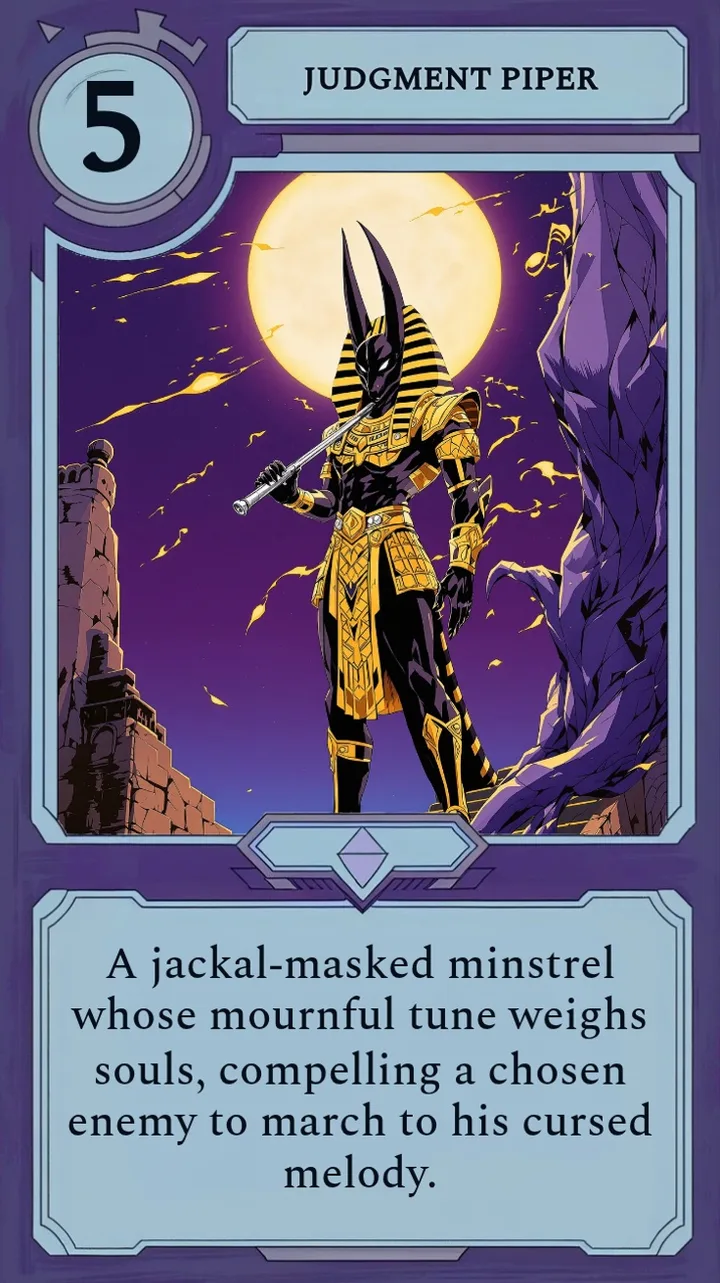
A cost cannot go below 0. At the top, a card that is still too strong at 10 mana is banned. It shows a Banned badge on the Decks screen and cannot be added to a deck, and a deck that holds it cannot be used for a match until the card is swapped out.
A ban is not forever. After 90 days the card comes back at 10 mana, on trial, so the game can measure it again:
- If it is still too strong after 100 fresh matches, it is banned again, and every repeat ban doubles the wait, up to a year.
- If it lands in the balanced band, the trial ends and it stays.
- If it turns out too weak, it gets cheaper like any other card.
What it means for your collection
A cost change applies to the card itself, so every copy in every collection and deck gets the new cost. You keep your cards. A card that gets cheaper may open up a deck that did not work before, and one that gets dearer may still earn its place in the right deck.
The limits
This is careful bookkeeping, not proof that a card won a match. A strong player or a strong deck lifts every card in it, and a card can look weak only because it keeps being paired with the wrong ones. That is why the bar is high, the steps are small, and both checks have to agree. The team can still change a cost by hand when it must, and such a change goes into the same record and restarts the count in the same way.
No AI model takes part in any of this. The AI card designer picks a new card's first cost and the AI Game Master decides what cards do on the board, but from then on the price is set by plain arithmetic on how matches end.
Want to see what the cards cost today? Open Moonfall and build a deck.
Frequently asked questions
Does Moonfall balance its cards automatically?
Yes. Every public card's mana cost follows its results in Multiplayer matches. When decks with a card clearly win more than they should, it costs one mana more; when they clearly lose more, it costs one mana less. The game checks again as new matches come in.
Do my games against the AI change card costs?
No. Only Multiplayer matches between two players can move a cost. Solo Adventure results are kept separately and never change one, and tutorials do not count at all.
What happens to the copies I already own?
You keep them. A cost change applies to the card itself, so every copy in every collection and deck gets the new cost.
Can a card be banned?
Yes. A card that is still too strong at 10 mana is banned from decks for 90 days. It then comes back at 10 mana on trial. If it is still too strong, it is banned again, and every repeat ban doubles the wait, up to a year.
Does an AI decide the costs?
No. The AI card designer gives a new Moon Foundry card its first cost, but after that only match results move it, by plain arithmetic. No AI model takes part in balancing.